
-
format
Self Paced
-
Level
Intermediate
-
eNROLMENT
Open
-
Duration
30 hours
-
Certificate
Digitally Verifiable
Sustainable Finance Executive certificate: Global Principles, Practices and Innovations
Why this course — and why now?
an evolving landscape
- Climate finance reached an estimated $1.5-$1.6 trillion in 2023, while cumulative climate-aligned sustainable debt passed $6 trillion in 2025.
- Yet, far more capital must be steered and evidenced with rigour. At the policy and reporting layer, 36 jurisdictions have adopted or are finalising use of the ISSB sustainability disclosure standards, and 47 sustainable finance taxonomies have been issued globally to define what “green” really means—accelerating comparability and capital reallocation.
- Regarding commitments, the GFANZ net-zero alliances now comprise 629 financial institutions representing $88 trillion in assets. Meanwhile, corporates are also moving quickly: 8,896 companies have validated SBTi targets, and the number of companies setting both near-term and net-zero targets has more than tripled since the end of 2023.
The Finance Career
Pivot the World's
$6 Trillion Green
Economy Demands
The Sustainable Finance Executive Certificate gives you the strategic insight, technical depth, and confidence to lead the transition to green, more inclusive and resilience economy.
across banking, investment & policy


net-zero alliances

— and growing fast
Develop in demand expertise to keep pace with market transition.
Sustainable finance is a means of implementation for the much needed sustainability transition and Agenda 2030 for Sustainable Development. It is where policy, capital, and corporate strategy converge. Professionals with knowledge of this intersection are being promoted, hired across borders, and trusted to lead an increasing volume of innovative finance deals.
Strategic Positioning
Ground yourself in the language regulators, investors, and board directors are now expected and required to speak.
Technical Depth
From ISSB disclosures to carbon accounting, from transition finance to green FinTech — frameworks applied across 36+ jurisdictions.
Global Relevance
Case studies drawn from all geographies.
Application
Every module is practice-first. Allows you to apply concepts directly to your context.
10 Modules
how finance is transforming.
Designed for working professionals. Each module builds your ability to analyse, advise, structure, and lead in sustainable finance — across the entire value chain from retail banking to capital markets.
Enroll Now →Introduction to Green & Sustainable Finance
Definitions, market evolution, ethical frameworks, and the global landscape of sustainability in finance.
Finance in a Changing World
Climate system fundamentals, macro-financial impacts, and implications for financial stability and systemic risk.
Monitoring Finance Flows & Environmental Impact
Tracking climate-aligned capital, carbon accounting methodologies, and ESG data quality and standards.
Climate & Environmental Risk Management
Physical risk, transition risk, liability risk, scenario analysis, and climate stress testing frameworks.
Sustainable Banking
Retail to corporate banking, SME finance, project finance, and sustainable due diligence in practice.
Green Bonds & Sustainable Capital Markets
Structuring green and sustainability-linked instruments, third-party review, and impact reporting standards.
Central & Development Banks
Supervisory expectations, blended finance, just transition frameworks, and development finance innovation.
Equity Markets & Sustainable Investment
ESG integration in equities, stewardship strategies, sustainable index design, and active ownership.
Insurance & Climate Risk
Climate-sensitive underwriting, catastrophe bond markets, risk transfer mechanisms, and resilience finance.
Green & Sustainable FinTech
AI-driven ESG analysis, blockchain for transparency, digital rails for sustainable finance, and data integrity.
Built for Three Kinds
of Ambitious Professionals

You lead teams, desks, or institutions
You're already senior. You don't need theory — you need the strategic and regulatory literacy to embed sustainability across your mandate. This accelerates that repositioning.

You work in financial markets daily
Bankers, analysts, fund managers, risk officers, and compliance professionals who need rigorous, applicable knowledge to go deeper — and advance faster.

You're building the career of the future
Finance graduates and early-career professionals who understand that ESG and sustainability are where the most interesting and impactful careers will be built.
A Certificate That
Validates Comptence
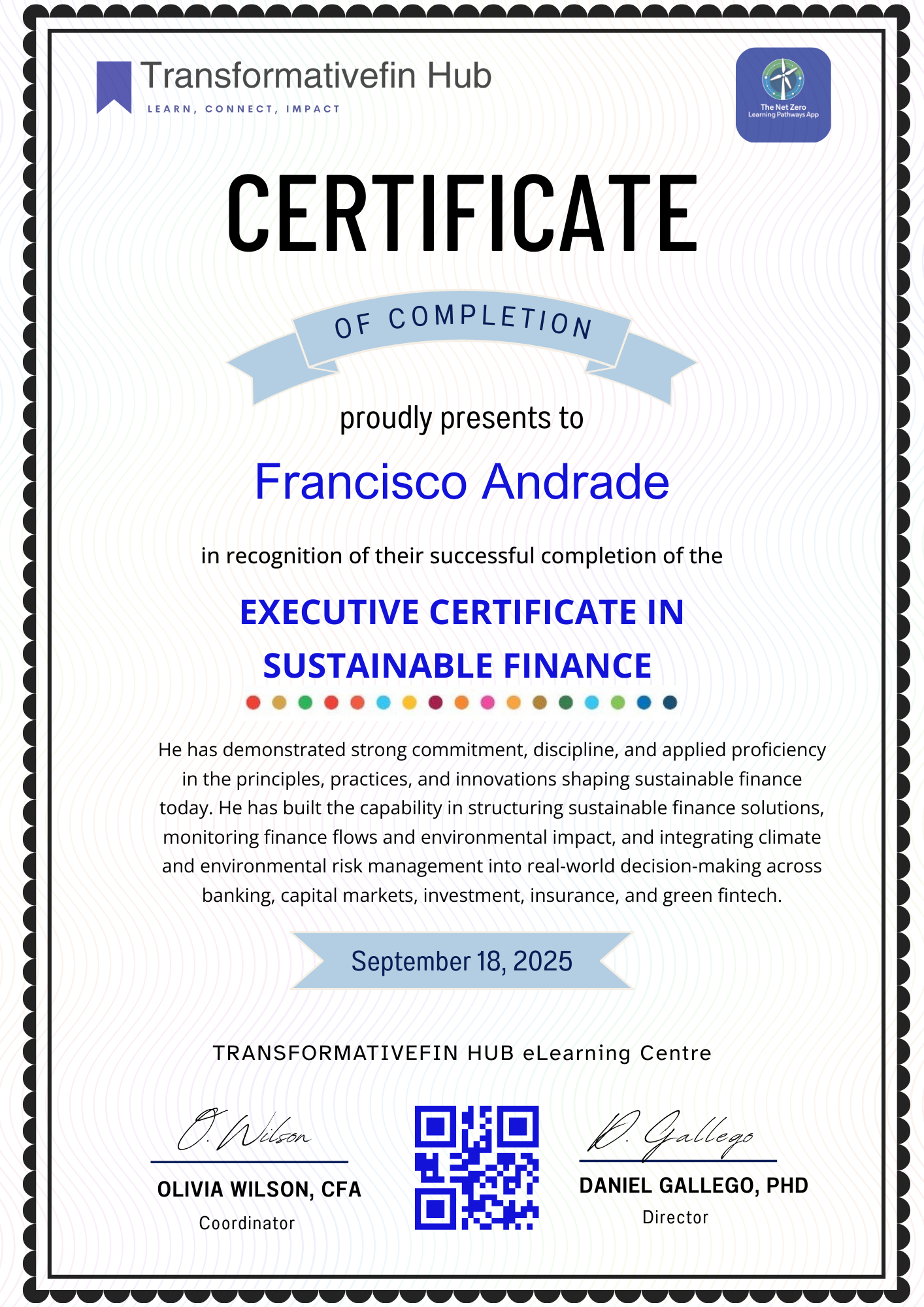
The Sustainable Finance Executive Certificate is digitally verifiable and shareable directly to LinkedIn, client profiles, and institutional CVs. It positions you as part of a growing global community of finance professionals actively leading the green transition.
The Roles You'll Be
Ready to Compete For
Here are fastest-growing roles in global financial services — and they demand exactly the knowledge this programme builds.

Designed Around
Your Reality as a
Working Professional
No rigid schedules. This is a programme built for professionals who need depth, application, and flexibility in equal measure.
Customised Learning Path
100% self-paced interactive lessons, expert eBooks, videos, and sector-specific resources adapt to your background and goals.
Dedicated Learning Assistant
You're assigned a personal Virtual Learning Support specialist matched to your time zone. Never study alone.
Role-Relevant Practice Tasks
Choose tasks aligned to your sector. Every submission receives expert practitioner feedback — not automated grading.
12-Month Post-Certificate Access
Stay current with expert webinars, updated materials, and a global closed community after completion.
The Questions the
World Is Now Asking Finance
These are the real conceptual questions practitioners, investors, and regulators debate daily. Insights that await you in the programme.
What is the difference between ESG integration and sustainable investing — are they the same thing?
No — and conflating them is a costly misunderstanding. ESG integration is an analytical process: incorporating environmental, social, and governance data into financial analysis to better assess risks and returns. It does not necessarily imply a sustainability outcome; a fund can integrate ESG factors and still hold fossil fuel companies if they appear financially attractive. Sustainable investing involves intentional capital allocation choices — selecting, tilting, or excluding assets based on sustainability criteria or impact objectives. The distinction matters enormously for regulatory disclosure, client communication, and how you construct and defend your investment mandate.
What are physical and transition climate risks, and why do they appear on bank balance sheets?
Physical climate risks arise from the direct impacts of a warming planet — floods, droughts, extreme heat, sea-level rise — which damage assets, disrupt supply chains, and reduce collateral values. Transition risks emerge from the policy, technology, and market shifts required to decarbonise — stranded fossil fuel assets, carbon taxes, rapid shifts in consumer preferences. Central banks including the Bank of England and ECB now conduct climate stress tests precisely because these risks can crystallise simultaneously across entire loan portfolios, insurance books, and investment funds. Finance professionals who cannot quantify and manage these risks are increasingly liabilities to their institutions.
What is a green bond, and how is it different from a conventional bond?
A green bond is a fixed-income instrument where proceeds are exclusively used to finance projects with defined environmental benefits — renewable energy, energy efficiency, clean transportation, sustainable water management. What distinguishes it is not the financial structure but the use-of-proceeds commitment and disclosure architecture around it. Issuers align with ICMA Green Bond Principles, obtain second-party opinions, and report on allocation and environmental impact. Sustainability-linked bonds go further — tying the cost of capital to the issuer achieving measurable sustainability performance targets, shifting the mechanism from proceeds-use to performance incentives.
What is the ISSB and why are its standards considered the global baseline for sustainability disclosure?
The International Sustainability Standards Board (ISSB) was established by the IFRS Foundation in 2021 to create a globally consistent baseline for sustainability-related financial disclosures. Its two standards — IFRS S1 (general sustainability disclosures) and IFRS S2 (climate-related disclosures) — build on the TCFD framework and require reporting on sustainability risks material to enterprise value. As of 2025, 36 jurisdictions have adopted or are finalising ISSB standards — making them the de facto global language of corporate sustainability disclosure. Finance professionals who understand ISSB mechanics can perform superior analysis and advise issuers on compliant disclosure architecture.
What is carbon accounting and how does it relate to corporate net-zero strategies?
Carbon accounting is the systematic measurement of greenhouse gas emissions — expressed in tonnes of CO₂-equivalent — across an organisation's operations and value chain. The GHG Protocol defines three scopes: Scope 1 covers direct emissions; Scope 2 covers purchased energy; Scope 3 covers all indirect emissions including a bank's financed emissions and an insurer's investment assets. Net-zero strategies are only credible if grounded in rigorous carbon accounting — without it, companies cannot set meaningful SBTi targets, demonstrate progress to investors, or meet emerging regulatory disclosure requirements.
What is transition finance and why is it at the centre of the sustainable finance debate?
Transition finance refers to capital directed toward activities that are currently high-emission but credibly moving toward a low-carbon economy. Without it, the steel, cement, aviation, and shipping industries — which cannot decarbonise overnight — have no access to sustainability-labelled capital, slowing decarbonisation. With it, there comes a risk of locking in carbon-intensive assets under the guise of transition. Getting this balance right demands knowledge of sector-specific pathways, science-based benchmarks, and the regulatory frameworks that define what qualifies.
What is a sustainable finance taxonomy and why does it matter to banks and investors?
A sustainable finance taxonomy is a classification system defining — in technical and legal terms — which economic activities qualify as environmentally sustainable. By 2025, 47 taxonomies have been issued globally. The EU Taxonomy sets performance thresholds across six environmental objectives and requires activities to "Do No Significant Harm" to others. For investors, taxonomies determine which assets qualify for green products. For banks, they shape which loans can be classified as green in regulatory filings. For companies, they affect access to green-labelled capital.
What is the just transition and why should finance professionals care about it?
The just transition principle requires that the shift to a low-carbon economy must be managed fairly — particularly for workers in fossil fuel industries and for developing economies that contributed least to climate change but face its worst consequences. For finance professionals, this creates opportunities in development finance, shapes how corporate transition plans are scrutinised by regulators and investors, and drives innovation in sustainability-linked debt for emerging market issuers. The professionals who understand this intersection of climate policy, social equity, and capital markets can advise governments and DFIs on the most appropriate direction and how to design transition finance products.
Your Entry Into the
Green and Sustainable Economy Opportunities
Green and Sustainable Finance is becoming mainstream
Stay ahead of the transition.
Regulators are mandating. Investors are demanding. Companies are committing. You can still catch up and position yourself to win in the transition.
What the programme covers
Emerging roles this certificate can position you for
Learning support