Build Sustainable Finance Skills
the World's
$6 Trillion Green
Economy Demands
The Sustainable Finance Executive Certificate gives you the strategic insight, technical depth, and confidence to lead the transition to a green, more inclusive and resilient economy.
across banking, investment & policy

net-zero alliances
10 Modules
how finance is transforming.
Each module builds your ability to analyse, advise, structure, and lead in sustainable finance, across the entire value chain from retail banking to capital markets.
Enroll Now →Introduction to Green & Sustainable Finance
Traces the shift from shareholder primacy to the stakeholder model underpinning today's ESG frameworks, and maps how sustainable finance moved from a niche in ethical investing into a mainstream discipline across banking, asset management and capital markets.
Finance in a Changing World
Explains the mechanics of the carbon cycle and the pathways set out in the Paris Agreement, then connects them to the macro-financial channels through which warming reaches growth, inflation and the balance sheets central banks are mandated to protect.
Monitoring Finance Flows & Environmental Impact
Works through the GHG Protocol's Scope 1, 2 and 3 boundaries, the PCAF methodology banks use to calculate financed emissions, and the data quality gaps that still separate reported figures from verified ones across emerging and developed markets.
Climate & Environmental Risk Management
Separates physical risk from transition risk using the TCFD taxonomy, then walks through how climate stress tests such as the Bank of England's exploratory scenario and the NGFS suite are used to pressure-test loan books and insurance portfolios.
Sustainable Banking
Follows sustainability through the bank balance sheet, from retail green mortgages and SME green lending lines to project finance due diligence under the Equator Principles, with attention to how smaller institutions build these capabilities without a dedicated ESG desk.
Green Bonds & Sustainable Capital Markets
Compares the use-of-proceeds structure behind the ICMA Green Bond Principles with the KPI-linked coupon mechanics of sustainability-linked bonds, and covers what a second-party opinion actually verifies before an issuer can bring either instrument to market.
Central & Development Banks
Reviews how supervisors are building climate risk into prudential expectations, and how multilateral development banks structure blended finance, first-loss capital and guarantee instruments to move private capital into just transition projects.
Equity Markets & Sustainable Investment
Distinguishes ESG integration from exclusionary screening and thematic investing, examines how index providers construct sustainable indices, and looks at stewardship in practice through engagement escalation and proxy voting on shareholder resolutions.
Insurance & Climate Risk
Explains how insurers price climate-sensitive underwriting risk as physical hazards become harder to predict, the mechanics behind catastrophe bonds and parametric insurance, and the role risk transfer instruments play in keeping coverage available in exposed markets.
Green & Sustainable FinTech
Covers how AI models are being used to close ESG data gaps and flag greenwashing in disclosures, how blockchain is being piloted for carbon credit registries and green bond settlement, and the practical limits of both technologies in current deployments.
A Certificate That
Validates Competence
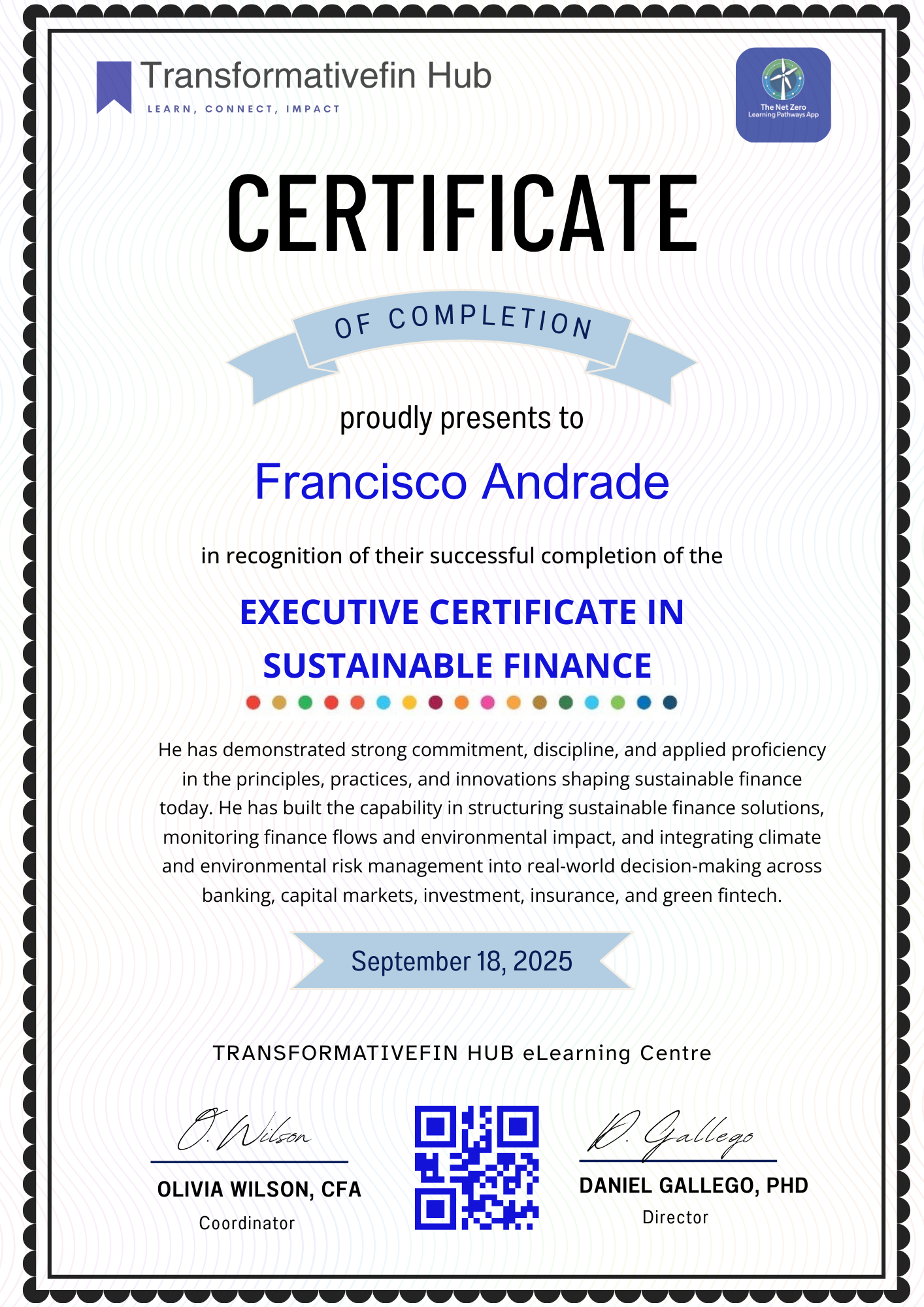
The Sustainable Finance Executive Certificate is digitally verifiable and shareable directly to LinkedIn, client profiles, and institutional opportunity CVs. It positions you as part of a growing global community of finance professionals ready to lead the green transition.
Built for Three Kinds
of Ambitious Professionals

You lead teams, desks, or institutions
You're already senior. You need the strategic and regulatory literacy to embed sustainability across your mandate. This programme accelerates that repositioning.

You work in financial markets daily
Bankers, analysts, fund managers, risk officers, and compliance professionals who need rigorous, applicable knowledge to go deeper and advance faster.

You're building the career of the future
Finance graduates and early-career professionals who see that ESG and sustainability are where the most impactful careers will be built over the next decade.
The Questions the
World Is Now Asking Finance
These are the real conceptual questions practitioners, investors, and regulators debate daily. Insights that await you in the programme.
What is the difference between ESG integration and sustainable investing, are they the same thing?
No, and conflating the two is a costly misunderstanding. ESG integration is an analytical process. It incorporates environmental, social, and governance data into financial analysis to better assess risks and returns, and it does not necessarily imply a sustainability outcome. A fund can integrate ESG factors and still hold fossil fuel companies if they appear financially attractive. Sustainable investing involves intentional capital allocation choices, selecting, tilting, or excluding assets based on sustainability criteria or impact objectives. The distinction matters for regulatory disclosure, client communication, and how you construct and defend your investment mandate.
What are physical and transition climate risks, and why do they appear on bank balance sheets?
Physical climate risks arise from the direct impacts of a warming planet, including floods, droughts, extreme heat, and sea-level rise, which damage assets, disrupt supply chains, and reduce collateral values. Transition risks emerge from the policy, technology, and market shifts required to decarbonise, such as stranded fossil fuel assets, carbon taxes, and rapid shifts in consumer preferences. Central banks including the Bank of England and the ECB now conduct climate stress tests because these risks can crystallise simultaneously across entire loan portfolios, insurance books, and investment funds. Finance professionals who cannot quantify and manage these risks are increasingly a liability to their institutions.
What is a green bond, and how is it different from a conventional bond?
A green bond is a fixed-income instrument where proceeds are used exclusively to finance projects with defined environmental benefits, such as renewable energy, energy efficiency, clean transportation, and sustainable water management. What distinguishes it is not the financial structure but the use-of-proceeds commitment and disclosure architecture around it. Issuers align with ICMA Green Bond Principles, obtain second-party opinions, and report on allocation and environmental impact. Sustainability-linked bonds go further, tying the cost of capital to the issuer achieving measurable sustainability performance targets, which shifts the mechanism from proceeds use to performance incentives.
What is the ISSB and why are its standards considered the global baseline for sustainability disclosure?
The International Sustainability Standards Board (ISSB) was established by the IFRS Foundation in 2021 to create a globally consistent baseline for sustainability-related financial disclosures. Its two standards, IFRS S1 for general sustainability disclosures and IFRS S2 for climate-related disclosures, build on the TCFD framework and require reporting on sustainability risks material to enterprise value. As of 2025, 36 jurisdictions have adopted or are finalising ISSB standards, making them the de facto global language of corporate sustainability disclosure. Finance professionals who understand ISSB mechanics can perform sharper analysis and advise issuers on compliant disclosure architecture.
What is carbon accounting and how does it relate to corporate net-zero strategies?
Carbon accounting is the systematic measurement of greenhouse gas emissions, expressed in tonnes of CO₂-equivalent, across an organisation's operations and value chain. The GHG Protocol defines three scopes. Scope 1 covers direct emissions, Scope 2 covers purchased energy, and Scope 3 covers all indirect emissions including a bank's financed emissions and an insurer's investment assets. Net-zero strategies are only credible when grounded in rigorous carbon accounting. Without it, companies cannot set meaningful SBTi targets, demonstrate progress to investors, or meet emerging regulatory disclosure requirements.
What is transition finance and why is it at the centre of the sustainable finance debate?
Transition finance refers to capital directed toward activities that are currently high-emission but credibly moving toward a low-carbon economy. Without it, the steel, cement, aviation, and shipping industries, which cannot decarbonise overnight, have no access to sustainability-labelled capital, which slows decarbonisation. With it, there comes a risk of locking in carbon-intensive assets under the guise of transition. Getting this balance right demands knowledge of sector-specific pathways, science-based benchmarks, and the regulatory frameworks that define what qualifies.
What is a sustainable finance taxonomy and why does it matter to banks and investors?
A sustainable finance taxonomy is a classification system that defines, in technical and legal terms, which economic activities qualify as environmentally sustainable. By 2025, 47 taxonomies have been issued globally. The EU Taxonomy sets performance thresholds across six environmental objectives and requires activities to "Do No Significant Harm" to others. For investors, taxonomies determine which assets qualify for green products. For banks, they shape which loans can be classified as green in regulatory filings. For companies, they affect access to green-labelled capital.
What is the just transition and why should finance professionals care about it?
The just transition principle requires that the shift to a low-carbon economy be managed fairly, particularly for workers in fossil fuel industries and for developing economies that contributed least to climate change but face its worst consequences. For finance professionals, this creates opportunities in development finance, shapes how corporate transition plans are scrutinised by regulators and investors, and drives innovation in sustainability-linked debt for emerging market issuers. Professionals who understand this intersection of climate policy, social equity, and capital markets can advise governments and DFIs on how to design transition finance products responsibly.
Your Entry Into the
Green and Sustainable Economy Opportunities
Stay informed about new resources and opportunities.