
Mar 16
/
Shikha Thakur
What are green patents, who leads the race?
A“ green patent” is simply a patent on an eco-friendly technology – for example in solar or wind power, clean transport, water conservation, or pollution control
Write your awesome label here.
Write your awesome label here.
Write your awesome label here.
Write your awesome label here.
Write your awesome label here.
Write your awesome label here.
Write your awesome label here.
Write your awesome label here.
Write your awesome label here.
Green patents are intellectual property rights granted for technologies that reduce environmental impacts or enable sustainable resource use. These innovations include renewable energy systems, energy-efficient technologies, pollution-control processes, and sustainable materials. By protecting environmentally beneficial inventions, green patents provide innovators with economic incentives while accelerating the transition toward a low-carbon economy.
Each green patent falls under one or more IPC classes or a “Green Inventory” category. WIPO analysis typically divides green tech into (a) energy production (solar, fuel cells, waste energy) and (b) energy use/efficiency (efficient appliances, eco-friendly transport, etc.)
Write your awesome label here.
Under the PCT (Patent Cooperation Treaty) system, environmental technology applications increased by around 120% between 2006 and 2020.Major patent-producing countries include China, Japan, the United States, Germany, and South Korea, which together account for more than three-quarters of global green patent filings.
Globally, 𝒐𝒖𝒕 𝒐𝒇 3.7 𝒎𝒊𝒍𝒍𝒊𝒐𝒏 𝒑𝒂𝒕𝒆𝒏𝒕𝒔, 308 000 (8%) 𝒂𝒓𝒆 𝒄𝒍𝒂𝒔𝒔𝒊𝒇𝒊𝒆𝒅 𝒂𝒔 𝒈𝒓𝒆𝒆𝒏 𝒑𝒂𝒕𝒆𝒏𝒕𝒔.
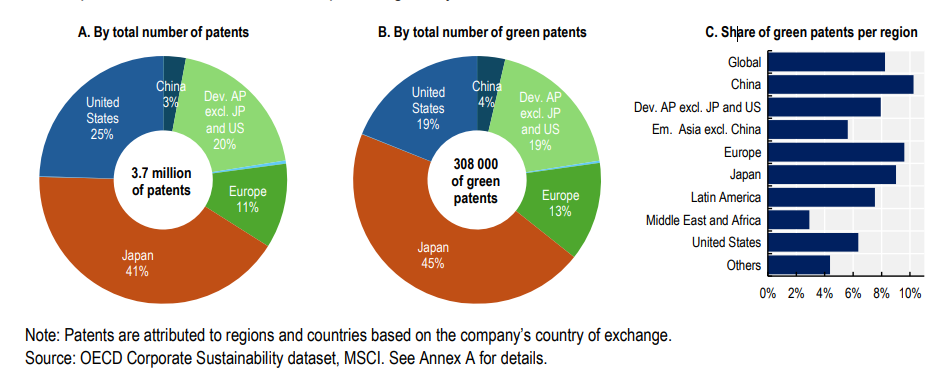
Based on IPC‑coded environmental patents only
Despite increasing attention to sustainability innovation, most developing economies remain underrepresented in green patent activity. Industrial firms from developing countries excluding China account for less than 2% of global green patents, a significant innovation gap. Nonetheless, emerging innovation clusters are beginning to appear in countries such as India, Brazil, and Southeast Asian economies, particularly in areas such as climate-resilient agriculture and decentralized renewable energy technologies.
In India, for example, nearly half of all patents granted between 2016 and 2021 were in green technologies. Data from India’s industry ministry report 61,186 green patents in that period (roughly one every 12 minutes of working time). Of these, 63% were for waste management innovations and 26% for alternative energy production (mostly solar, biofuels, etc), with smaller shares in energy conservation, transport, nuclear or agricultural technologies.
Challenges in Green Patenting
Despite their promise, green patents pose complex challenges. Key issues include:
-
Patent “thickets” and fragmentation: Complex climate solutions often require multiple patented components (e.g. a smart grid may involve dozens of patents). This creates overlapping IP rights that innovators must navigate. Dense patent thickets can lead to expensive licensing negotiations or litigation, delaying deployment of green tech. For instance, major battery firms (Tesla/Panasonic) hold core lithium-ion patents, raising the barrier for new entrants.
-
High costs and hold-ups: Obtaining and defending patents is costly, which can deter startups or limit competition. The expense of filing and renewal fees worldwide can keep small firms out of the market. Incumbents can also use patents strategically (so-called “patent hold-up”) to demand large royalties from competitors, stifling diffusion of technology. Such tactics are especially harmful in green tech, where collaboration and widespread adoption are needed.
-
Access and equity: Patented green technologies can be unaffordable for low-income countries. Experts warn that IP exclusivity may restrict access to crucial climate innovations, e.g. by limiting affordable vaccines or solar panels. Developing countries often lack harmonized IP regimes, so a patent granted in one country may have no effect elsewhere. This uneven protection (and often weaker enforcement in poorer nations) can hamper global diffusion of climate solutions.
-
Incentive misalignment: Ironically, some innovators prefer slow patent processing. For example, accelerated grants (while shortening patent pendency by 42–75%) may force early disclosure, and could lock an invention into narrower claims than needed. Inventors often delay filing or examination to refine their technology, so fast-track uptake has remained small (typically only 1–2% of eligible green apps, except in a few offices).
-
Policy and ethical debates: There are ongoing debates over whether patents should ever be waived for climate reasons. Some argue that, as with HIV drugs, compulsory licensing or open-access patents might be justified for critical green tech in a climate emergency. Others counter that strong IP is needed to incentivize R&D in the first place. The balance between rewarding inventors and ensuring public need is a live policy question (echoing discussions at UN climate forums).
Policy Responses and Future Directions
To tackle these challenges, governments and organizations have experimented with innovative responses:
-
Fast-track examination: As noted, many patent offices allow applicants to expedite green patents. In these programs, an application’s pendency can fall from years to months, encouraging clean-tech investors. Early studies find fast-track patents are often of higher commercial value, though participation rates vary by country.
-
Patent pools and licensing models: Pooling related patents into a single license can reduce thickets. Cross-licensing or “patent commons” approaches let companies share technology without endless fees. For example, industries like solar and EVs have created joint ventures and standards that ease access to key IP. Some experts propose open-source models or FRAND licensing terms for green tech, to balance rights and access.
-
Public-private partnerships: Governments often fund green innovation directly to supplement IP incentives. Grants, tax credits or prizes for clean-tech R&D can make up for weaker paten incentives. Start-up accelerators focused on climate tech (with mentorship and funding) can help bring inventions to market more quickly. Meanwhile, platforms like WIPO GREEN (an online marketplace) connect inventors of sustainable technologies with users and investors worldwide, promoting technology transfer.
-
Capacity building and cooperation: To address global gaps, international treaties (e.g. the Paris Agreement, TRIPS flexibilities) encourage tech transfer to developing nations. Some governments are establishing patent disclosure requirements (green registries) or specialized courts for environmental cases. Education programs can train innovators in IP strategy while aiding local adaptation of technologies.
“Patents play a crucial role in driving innovation in green technology… [but] sustainable development requires a balance between incentives for innovation and the need for widespread access to solutions. By fostering a collaborative environment, the world can ensure that patents serve as a catalyst, rather than a barrier, to climate action”
Empty space, drag to resize
Relevant papers for further reading:
Empty space, drag to resize