
Is Your Institution's ESG Strategy transformational or operationally surface level?
Most financial institutions have published ESG commitments. Far fewer can demonstrate that those commitments are fully embedded in ther core growth strategy, independently verifiable, and linked to capital allocation decisions. This diagnostic guide is designed give practitioners and decision-makers a basis to distinguish credible sustainability leadership from reputational positioning.
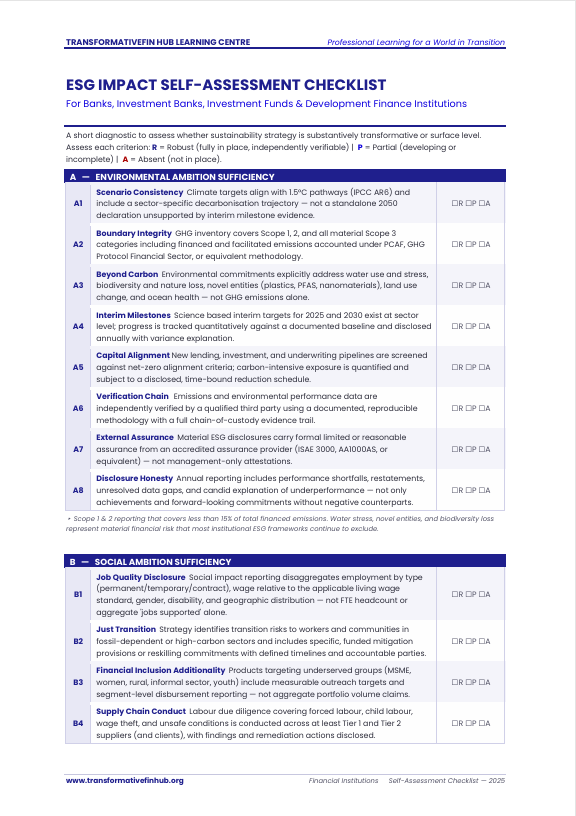
The Problem This Guide Addresses
The volume of ESG commitments published by financial institutions has grown substantially over the past decade. Net-zero pledges, sustainable finance frameworks, impact reports, and labelled product suites have become standard features of institutional communications. The commitment volume and commitment quality are not the same thing — and the gap between them has widened as ESG has become an expectation and mandatory.
Commonly identified gaps include climate targets set at the headline portfolio level without interim milestones or sector-specific decarbonisation trajectories. GHG accounting is confined to Scope 1 and 2, leaving the financed and facilitated emissions that constitute the over 75% of a financial institution's climate footprint outside the boundary. Social reporting aggregates employment outcomes without wage data, permanence, or disaggregation by gender or marginalised group. ESG risk assessment operates as a parallel advisory process rather than a mechanism with the authority to block or condition a transaction. And labelled financial products are extended to borrowers and issuers who would have accessed identical terms without the ESG designation — reclassification presented as additionality.
What the Checklist Covers
The ESG Impact Self-Assessment Checklist for Financial Institutions is a 28-criterion across five dimensions. Each criterion is rated Robust, Partial, or Absent.
The proportion of Robust ratings indicates strategic maturity. 75–100% Robust reflects leading practice — pursue frontier differentiation and peer benchmarking. 50–74% signals a progressing institution — address gaps in product design, capacity, and boundary integrity. Below 50% indicates foundational gaps requiring strategy redesign, not incremental refinement.
This learning material is developed for discussion and professional development purposes. It is not a substitute for regulatory, legal, or ESG advisory guidance. © 2025 TRANSFORMATIVEFIN HUB LEARNING CENTRE.