Own Your Words
A Professional Self-Editing Guide for the Age of AIAI drafting tools produce writing that passes every surface check, correct grammar, familiar structure, professional vocabulary that sounds right for the room. What that writing cannot supply is proof that the person sending it knew this exact situation before describing it. This book gives you four editorial tests, nine named AI writing patterns, and a full worked workflow for closing that gap before you click send.
$10 through 31 July 2026 · $45 from 1 August 2026 · instant PDF download
Two specific problems, not one vague one
Chapters 1 and 2 name what has actually changed in professional writing since AI drafting became routine, and why "make it sound more human" fixes neither problem.
Empty fluency
A draft can have correct grammar, the right structure, and exactly the vocabulary a reader expects, and still contain no detail that required direct knowledge of the situation. The book shows how to find the sentences where this is true, and what to put there instead.
Convergence
When enough people draft the same kind of message with the same tool, the output drifts toward the same phrases, the same structure, and the same register, regardless of who sent it or what organisation they work for. The book shows what a reader notices when that happens, and how to keep your own writing out of it.
Eight parts, in the order they're meant to be used
Each part builds on the one before it. Parts One through Three set up the method. Part Four names the patterns the method catches. Parts Five through Eight apply all of it to the formats most professionals write every week.
Diagnosis
Chapters 1–3What changed, why fluent writing and good writing are not the same thing, and how editorial judgment used to be taught at a desk, one sentence at a time.
Mentorship Method, Made Portable
Chapters 4–6The cognitive mechanism behind the old desk-side edit, a single client email taken through four full revisions, and why printing a draft changes what its writer notices.
Self-Editing System
Chapters 7–11The Voice, Defensibility, Necessity, and Sound Tests, applied in sequence, with timing for a complete edit of a standard professional document.
Nine AI Writing Patterns
Chapters 12–20Canonical adjectives, intensity words, unsupported superlatives, rhetorical characterisation, the advisory voice, the em-dash shortcut, rhetorical negation, audience address, and vague intensifiers, each named, catalogued, tested, and corrected.
Professional Email
Chapters 21–24Subject lines, openings, sequencing, and closings, including a fee-revision email taken from a vague first draft to a version a client can act on without a phone call.
Reports and Formal Documents
Chapters 25–27What separates a report from an argument, what an executive summary owes a reader who stops there, and how a proposal persuades through specifics rather than adjectives.
Short Form and Social Media
Chapter 28The announcement post, the professional biography, and the observational post, formats where one weak sentence is a third of the entire message.
Reclaiming Your Voice
Chapters 29–31What a generative tool cannot produce, how an editorial identity accumulates across a body of work, and the daily practice that keeps it from eroding.
Reference Section
pp. 431–endA pre-send checklist that combines all four tests with all nine patterns, a one-page quick-scan reference for the nine patterns, twenty-five before-and-after examples across email, report, proposal, biography, social post, and internal memo, and a list of further reading on professional writing and editing.
Four tests, applied in this order
Each test targets a different part of a draft, and the sequence is not optional. Chapter 11 explains why skipping the order wastes the effort. Together, a full pass takes forty-five to sixty-five minutes the first few times, and considerably less once the questions start running during composition rather than after it.
Voice Test
Could anyone in this field have written this sentence without knowing this specific situation? If yes, it isn't finished.
Defensibility Test
What evidence would this claim need, and is that evidence in the document? Applied to every word that assigns significance rather than reporting it.
Necessity Test
If this word were removed, what would the reader lose? Asked of every word, not just the obvious ones.
Sound Test
Read aloud, at the pace you'd use with a colleague. Rhythm problems and repeated words the eye skips past are audible immediately.
Anyone whose writing is read as evidence of their judgment
The examples throughout the book are drawn from client emails, status reports, proposals, internal escalations, professional biographies, and announcement posts, the documents most professionals produce every week, often with AI assistance, and almost never with a second reader before sending.
A.J. Thornfield
Lock in $10 before 1 August 2026
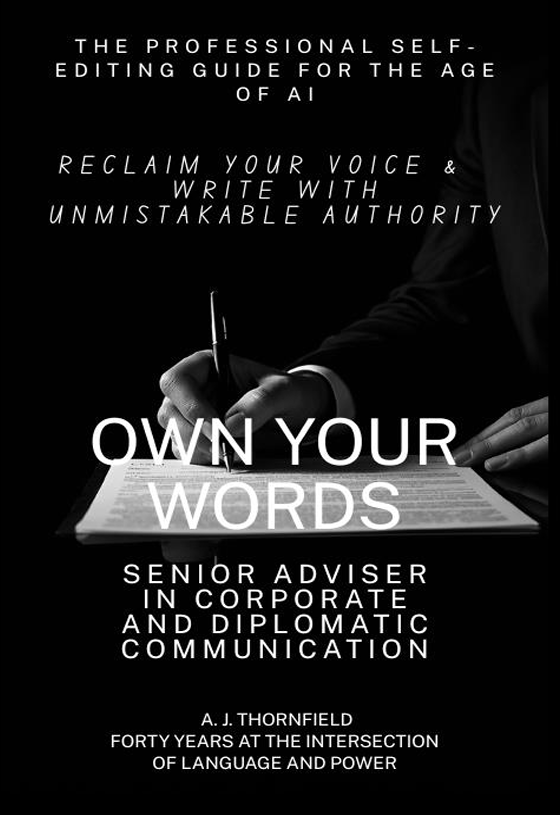
for the Age of AI Cover image
One payment. Instant download. No subscription.
- Complete PDF, 8 parts, 31 chapters, approx. 440 pages
- Appendices A through D, checklist, pattern reference, 25 worked examples, reading list
- Free sample chapter available before purchase
Bulk orders, institutional licences, and educational use reach us at e-library@transformativefinhub.org
Frequently asked questions
Six days left at $10. After that, $45.
Get It Now